
The Next Big Thing in Climate Action – mCDR!
As the urgency to address climate change intensifies, I find myself increasingly captivated by the promise of marine carbon dioxide removal (mCDR). The ocean, which covers more than 70% of Earth’s surface, is far more than a vast blue expanse—it’s a powerful and dynamic carbon sink with untapped potential to help us rebalance the atmosphere.
One of the most innovative and hopeful developments in this space is a new Microalgae Carbon Fixation and Sinking (MCFS) methodology. The methodology is being advanced by Gigablue and outlined in the latest Puro.earth draft standard. When this standard is published it will offer Gigablue and other followers the opportunity to take advantage of carbon finance to support their mCDR efforts. Puro earth is a relatively new GHG Registry with methodologies that support long-term carbon storage.
Key Takeaways
- Marine carbon dioxide removal (mCDR) leverages the ocean’s natural ability to absorb and store carbon to combat climate change.
- The proposed Microalgae Carbon Fixation and Sinking (MCFS) methodology enhances carbon capture through phytoplankton and deep-sea storage.
- The MCFS draft stands out for its scientific rigor, environmental safeguards, third-party verification, and long-term carbon storage.
- This approach avoids geoengineering risks by enhancing natural ocean processes.
- While marine carbon credits are still emerging, mCDR holds the promise of a scalable, durable, and nature-based climate solution.
The Ocean: Our Natural Partner in Carbon Removal
The ocean already plays a critical role in absorbing atmospheric CO₂, but natural processes alone are not enough to keep pace with human emissions. That’s where mCDR comes in.
By leveraging marine biology and ocean physics, we can accelerate and enhance the ocean’s natural carbon sequestration pathways. This approach uses marine ecosystems—particularly phytoplankton and deep-sea processes—to accelerate the ocean’s natural carbon cycle. These marine CDR strategies are emerging as essential tools in our transition to net-zero emissions.
How the MCFS Methodology Works
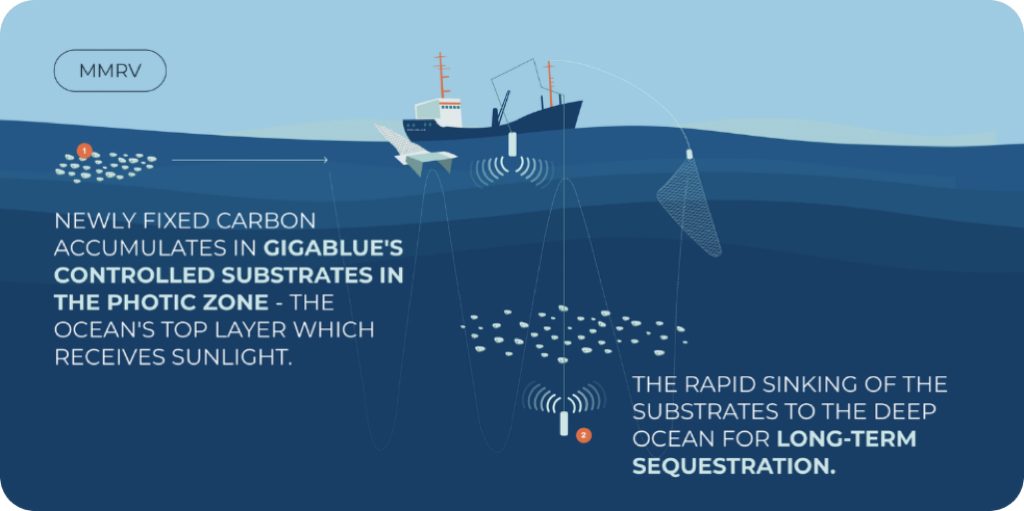
The MCFS approach is particularly exciting because it builds on the ocean’s own natural processes—using microalgae (phytoplankton) to fix carbon through photosynthesis. The methodology is limited to areas of the world oceans (20-30%) that have the specific and appropriate conditions; Subarctic North Pacific (SNP), the Eastern Equatorial Pacific (EEP), and the Southern Ocean (SO). Within these regions there are areas that have high nutrients, but low amounts of chlorophyll (HNLC). The HNLC ocean regions are missing a key nutrient(s); iron (Fe), cobalt (Co), zink (Zn), copper (Cu), nickel (Ni) or cadmium (Cd). The protocol calls for an organic substrate embedded with the missing micronutrients to be dispersed on the ocean surface within the defined HNLC zone. Phytoplankton grows on and in the organic substrate, and in two to three weeks, it naturally sinks to the ocean floor.
The vast majority of the sinking biomass remineralizes into dissolved inorganic carbon (DIC), which accumulates in deep waters and is isolated from the atmosphere on timescales of centuries to millennia. A gambit of measurements are taken before, during and after substrate deployment, monitoring the correctness and effectiveness of the followed protocol. The amount of carbon credits formed in an MCFS project is limited by the further uptake of atmospheric CO2 in the deployment area after the initial carbon removal.
What Sets the MCFS Method Apart
The draft MCFS methodology, now being considered by Puro.earth, sets a new mCDR bar for rigor, transparency, and environmental responsibility. The MCFS protocol is the first of several promissing mCDR techniques to remove atmospheric CO2 that is being considered for publication by any GHG Registry. Here’s what stands out to me:
1. Science-driven Design
The methodology is grounded in decades of ocean physics and biogeochemical research, ensuring that every step—from substrate design to site selection—is optimized for both effectiveness and safety.
2. Strict Environmental Safeguards
Only native phytoplankton species are utilized, and deployments are limited to High Nutrient, Low Chlorophyll (HNLC) regions, minimizing ecological disruption.
3. Comprehensive Monitoring
The framework requires robust pre- and post-deployment monitoring of nutrients, oxygen, biodiversity, and potential environmental risks, with clear protocols for data collection and third-party verification.
4. Long-Term Storage
Carbon is only credited if it’s demonstrably isolated from the atmosphere for at least 200 years, inline with deep ocean circulation and careful modeling of ocean currents and sediment dynamics.
5. Transparency and Accountability
Every project must undergo public consultation, third-party audits, and continuous stakeholder engagement. This ensures that community voices are heard and environmental justice is prioritized.
A New Frontier for Carbon Credits
What excites me most about marine carbon dioxide removal is its potential to deliver durable, measurable, and scalable carbon removal—creating new opportunities for sustainable blue economies. As we strive for net-zero, solutions like these offer hope that we can actively restore the balance of our planet’s carbon cycle.
mCDR is more than a technical innovation—it’s a chance to align with the planet’s own processes in the fight against climate change. By supporting scalable ocean-based solutions like MCFS, we can restore carbon balance while applying safeguards to marine health, providing a more hopeful climate future for us all.
Marine CDR carbon credits are not quite yet available, other than some early efforts at estuary restoration. Perhaps the real long-term large scale effective carbon removal and storage solutions will ultimately lie on the bottom of the deep blue sea.
Frequently Asked Questions About Marine-Based Carbon Dioxide Removal
What is marine carbon dioxide removal (mCDR)?
Marine carbon dioxide removal refers to climate solutions that make use of ocean processes to capture and store carbon dioxide from the atmosphere. These methods enhance the ocean’s natural carbon sink capabilities.
How does the MCFS methodology work?
The Microalgae Carbon Fixation and Sinking (MCFS) method uses local phytoplankton to absorb CO₂ through photosynthesis. The carbon is then transported to the deep ocean, where it can be securely stored for centuries.
Is marine-based carbon removal safe for the environment?
Yes—when done responsibly. Approaches like MCFS use only native species and are deployed in carefully selected regions to minimize ecological disruption. Projects must follow strict monitoring and verification protocols.
Are marine carbon credits available?
Marine carbon credits are still in the early stages of development. While some small-scale efforts exist, large-scale, verifiable marine CDR credits—like those proposed under the MCFS methodology—are still emerging. Evergreen Carbon can work with your organization to provide a future offtake agreement for new mCDR projects that are preparing to launch.
Why focus on the ocean for carbon removal?
The ocean naturally absorbs about 25% of human CO₂ emissions. Enhancing this capacity through marine-based solutions offers a scalable, durable, and nature-based way to fight climate change.
Ready to Dive Deeper into Marine-Based Carbon Removal?
As interest in mCDR grows, so does the opportunity to support innovative, science-driven solutions that work in harmony with our planet. Whether you’re a climate-conscious investor, policymaker, or simply passionate about protecting our oceans, now is the time to get involved.
Follow the latest developments, support responsible marine carbon initiatives, and join the movement to make the ocean a central player in climate recovery.
Contact us to learn how your organization can support or participate in marine carbon removal efforts.
Let’s harness the power of the ocean—together.